
Laser sail: choosing, trimming and maintaining your sail
The Laser, now known as ILCA within the international class, remains one of the most widely used single-handed dinghies in the world.
Simple to rig, easy to understand and demanding to master, it requires a suitable sail that is well trimmed and in good condition.
In this guide, we explain how to choose a Laser sail, the differences between rigs, which settings have the biggest impact on performance and which products can help you sail with a more reliable and consistent boat.
In this article
1. Why the sail is essential on a Laser
2. Understanding Laser 4.7, Radial and Standard / Sport sails
3. Which sail to choose according to your sailing style
4. Key controls: cunningham, vang, outhaul and mainsheet
5. When to replace your sail
6. Laser products available at Forward Watersports
Why the sail is central on a Laser
On a Laser, the sailor does everything.
You trim, steer, balance, accelerate and manage the power of the boat.
The sail is therefore the main engine of the dinghy.
A well-suited sail helps control the boat in the wind, accelerate more easily in light air and maintain consistent speed through transitions.
On the other hand, a sail that is too worn, poorly trimmed or not suited to the sailor’s size can make the boat unstable, physical or difficult to point.
Understanding the different Laser rigs
The Laser exists in several sail configurations.
The hull remains similar, but the sail area changes according to the sailor’s size, level and sailing conditions.
Laser 4.7
The Laser 4.7 is generally used by young sailors, lighter sailors or anyone looking for a sail that is easier to control.
Its reduced sail area helps limit power and allows sailors to progress more confidently in medium to strong wind.
Recommended product: Nautisails Laser 4.7 m² sail
The Nautisails Laser 4.7 m² mainsail is suited to sailors looking for a more accessible and easier-to-manage sail.
It is particularly suitable for young sailors, sailing schools and sailors who want to keep control when the wind increases.
Laser Radial
The Laser Radial offers a good balance between power, control and accessibility.
It is often chosen by intermediate sailors, lighter adults or racers who want a demanding boat without moving directly to the largest sail area.
Laser Standard / Sport
The Laser Standard, or Sport depending on commercial naming, uses a larger sail.
It requires more physical commitment and is aimed at stronger sailors or those looking for more speed and sensations.
Recommended product: new generation Laser-compatible sail
The new generation Laser-compatible sail is designed for sailors who want to replace their current sail and regain a cleaner feeling on the water.
It helps you sail with a more consistent sail, clearer trim response and better suitability for sporty sailing.
Which sail should you choose according to your sailing style?
The choice depends first on your size, level and objective.
To learn, progress or sail in changing conditions, a sail that is easier to handle can be preferable.
For a sportier sailing style, a more powerful sail helps you look for more speed, provided you can control it.
Simple guidelines:
1. Laser 4.7: young sailors, lighter sailors, learning and control
2. Laser Radial: progression, versatility and regular sailing
3. Laser Standard / Sport: stronger sailors, sporty sailing and speed focus
The controls that change everything
On a Laser, a few controls have a direct impact on power, balance and boat handling.
The cunningham, vang, outhaul and mainsheet must be adjusted according to the wind, water conditions and sailor level.
The cunningham
The cunningham controls luff tension.
When the wind increases, it helps flatten the sail and make the boat more stable.
The vang
The vang controls the leech and the overall shape of the sail.
It is a major control on a Laser, especially when the wind builds.
The outhaul
The outhaul acts on the lower part of the sail.
The tighter it is, the flatter the sail becomes.
The looser it is, the more power the sail keeps.
The mainsheet
The mainsheet controls the angle of the sail to the wind.
It also influences leech tension and the overall balance of the boat.
When should you replace your Laser sail?
A sail does not become unusable overnight.
It gradually deforms through sailing sessions, UV exposure, folding and repeated storage.
Signs to watch:
1. Loss of shape
2. Unstable leech
3. Marked creases
4. Less consistent trimming
5. Boat harder to balance
6. Feeling of lack of power or control
If your usual settings no longer give the same feeling, the sail may be the cause.
Before replacing fittings or questioning your technique, it is useful to check the actual condition of the sail.
Protecting your Laser between sessions
Performance does not only depend on the sail.
A well-protected boat ages better, stays cleaner and requires less maintenance.
A cover limits exposure to UV, rain, dirt and storage-related rubbing.
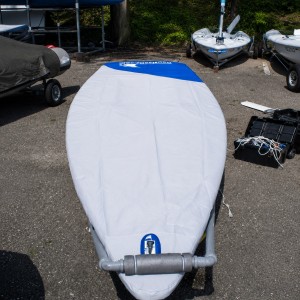
Recommended product: Nautisails Laser cover
The Nautisails Laser cover helps protect the boat when stored ashore or between sailing sessions.
It is a simple but important accessory to preserve the deck, reduce storage-related wear and keep the boat ready to sail for longer.
Our Laser selection at Forward Watersports
At Forward Watersports, we offer a selection of products to equip, maintain and protect your Laser.
You can choose a new generation Laser-compatible sail, a Nautisails Laser 4.7 m² mainsail or a Nautisails Laser cover depending on your needs.
Equip your Laser
Find the Laser sails and accessories available at Forward Watersports.
Sources
ILCA Sailing, Olympic Sailing: https://ilcasailing.org/olympic-sailing/
ILCA Sailing, Laser Cunningham, How to Trim: https://ilcasailing.org/laser-cunningham-how-to-trim/
Applied Sciences, GNSS Applications to Assess Performance in Olympic Sailors: Laser Class: https://www.mdpi.com/2076-3417/11/1/264